Genome annotation with DANTE_LTR and TideCluster on Galaxy
This protocol describes, step-by-step, how to use DANTE, DANTE_LTR, and TideCluster tools to annotate LTR-retrotransposons and tandem repeats in genome assemblies on the RepeatExplorer Galaxy server (https://repeatexplorer-elixir.cerit-sc.cz/ ). DANTE_LTR is specifically developed for annotating LTR-retrotransposons in Viridiplantae genomes, while TideCluster is applicable for annotating tandem repeats in any genome assembly.
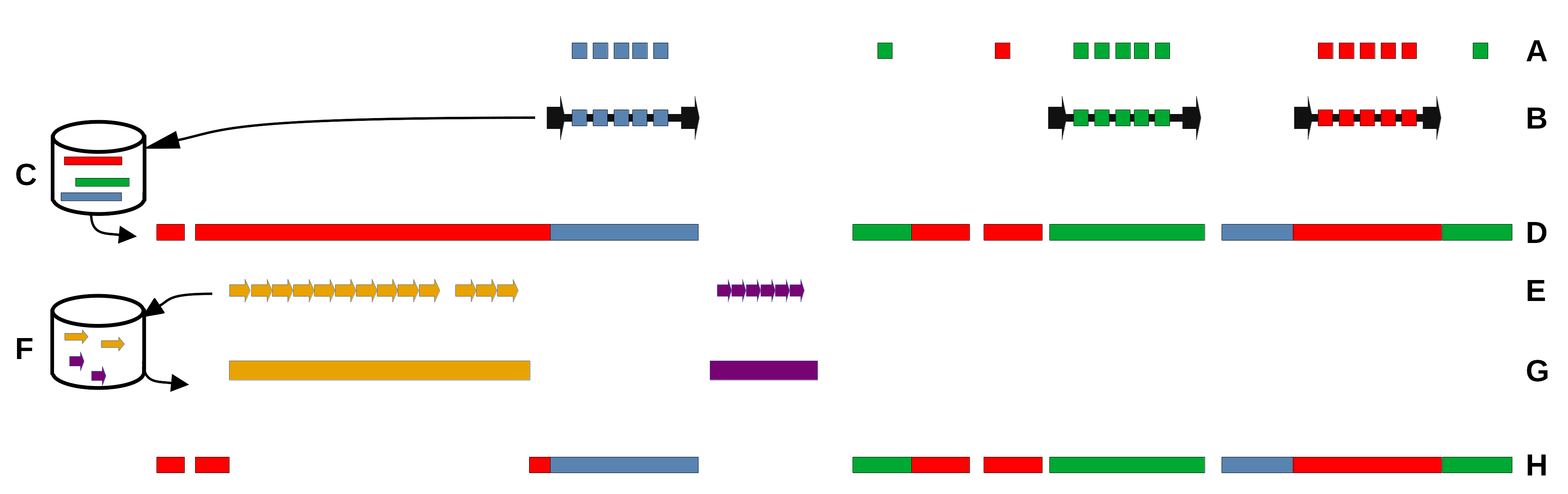 Workflow for annotating LTR-retrotransposons and tandem repeats in genome assemblies using the DANTE, DANTE_LTR, and TideCluster tools on the RepeatExplorer Galaxy server. The colored blocks represent the genomic features annotated at each step. (A) Identification of individual LTR-RT protein domains using the DANTE tool.
(B) Identification of complete LTR-retrotransposons using the DANTE_LTR tool based on DANTE domain annotations.
(C) Creation of a library of representative LTR-retrotransposons from complete elements.
(D) Use of the LTR-retrotransposon library to annotate remaining LTR-RTs in the genome assembly using a similarity-based approach. This step also allows for the annotation of incomplete LTR-RTs.
(E) Structure-based annotation of tandem repeats using the TideCluster tool.
(F) Preparation of a library of tandem repeats from the TideCluster output.
(G) Annotation of tandem repeats in the genome assembly using the library-based approach, filling gaps in the tandem repeat annotation provided by TideCluster.
(H) Improvement of LTR-RT annotation by subtracting tandem repeat annotations. This step is recommended to prevent misannotation of LTR-RTs due to similarities with tandem repeats.
Workflow for annotating LTR-retrotransposons and tandem repeats in genome assemblies using the DANTE, DANTE_LTR, and TideCluster tools on the RepeatExplorer Galaxy server. The colored blocks represent the genomic features annotated at each step. (A) Identification of individual LTR-RT protein domains using the DANTE tool.
(B) Identification of complete LTR-retrotransposons using the DANTE_LTR tool based on DANTE domain annotations.
(C) Creation of a library of representative LTR-retrotransposons from complete elements.
(D) Use of the LTR-retrotransposon library to annotate remaining LTR-RTs in the genome assembly using a similarity-based approach. This step also allows for the annotation of incomplete LTR-RTs.
(E) Structure-based annotation of tandem repeats using the TideCluster tool.
(F) Preparation of a library of tandem repeats from the TideCluster output.
(G) Annotation of tandem repeats in the genome assembly using the library-based approach, filling gaps in the tandem repeat annotation provided by TideCluster.
(H) Improvement of LTR-RT annotation by subtracting tandem repeat annotations. This step is recommended to prevent misannotation of LTR-RTs due to similarities with tandem repeats.
1. Input Data
Upload your genome assembly in FASTA format to the Galaxy server. The genome assembly file can be either in plain FASTA format or compressed using GZIP.
2. Annotation of LTR-Retrotransposons
2.1. Annotation of Transposable Elements Protein Domains with DANTE
- Tool : Domain-based Annotation of Transposable Elements (DANTE)
- Input Data :
- Sequence in FASTA format: uploaded genome assembly
- Parameters :
- Select REXdb database: Viridiplantae_v3.0
- Other parameters: default
This tool annotates LTR-RT protein coding domains using a similarity search against the REXdb database. The output includes:
- GFF3 file with the full DANTE output
- Filtered GFF3 file with domains that meet filtering criteria (minimum identity of 35%, minimum similarity of 45%, minimum alignment length of 80% of domain length, and a maximum of three interruptions such as frameshifts or stop codons)
- FASTA file with protein sequences of annotated domains
2.2. Annotation of Complete LTR-Retrotransposons with DANTE_LTR
- Tool : DANTE_LTR Retrotransposon Identification
- Input Data :
- GFF3 output from the DANTE tool: full output
- Reference sequence matching the DANTE output: genome assembly in FASTA format
- Parameters :
- Maximum number of missing protein domains tolerated in a full-length retrotransposon: 1
This tool identifies complete LTR-retrotransposons based on the DANTE output. The outputs include:
- GFF3 file with the full DANTE_LTR output
- Statistics of identified LTR-retrotransposons
- Graphical report in HTML format
2.3. Creation of a Library of LTR-Retrotransposons for Similarity-Based Annotation
- Tool : Create Representative Library from DANTE_LTR Output
- Input Data :
- GFF3 output from the DANTE_LTR pipeline
- Reference sequence matching the DANTE_LTR output: genome assembly in FASTA format
This tool creates a library of representative LTR-retrotransposons based on the DANTE_LTR output. This library is in FASTA format and is suitable for similarity-based annotation using tools like RepeatMasker to annotate incomplete (fragmented, non-autonomous, solo-LTR) LTR-RTs.
2.4. Similarity-Based Annotation of LTR-Retrotransposons with RepeatMasker
- Tool : Library-Based Assembly Annotation
- Input Data :
- Genome assembly to annotate: uploaded genome assembly in FASTA format
- Library of Repetitive Sequences: library of representative LTR-retrotransposons created in the previous step
- Parameters : use default parameters
This tool annotates LTR-retrotransposons in the genome assembly using RepeatMasker. The resulting annotations are provided in RepeatMasker format (.out) and as a GFF3 file. Overlapping annotations and conflicts are resolved based on classification hierarchy.
3. Annotation of Tandem Repeats
3.1. Annotation of Tandem Repeats with TideCluster
- Tool : TideCluster
- Input Data :
- Reference fasta: uploaded genome assembly
- Library: optional library in FASTA format
- Parameters : default settings report satellites with monomer lengths between 40-3000 nt. A consensus sequence is calculated for tandem repeats occupying at least 50,000 nt in the assembly.
The output consists of several files:
- GFF3 file with the annotation of tandem repeats
- HTML reports with detailed statistics, consensus, and graphical representation of tandem repeats
- FASTA file with consensus sequences of tandem repeats, which can be used for the similarity-based annotation of tandem repeats in the next step
- Archive with all output files
3.2. Annotation of Tandem Repeats in the Genome Assembly Using a Library-Based Approach
- Tool : TideCluster - Annotate Genome
- Input Data :
- Genome assembly to annotate: uploaded genome assembly in FASTA format
- Library of tandem repeats: library created in the previous step
This tool re-annotates tandem repeats using a similarity-based approach. It runs RepeatMasker using the tandem repeat library generated by TideCluster. The resulting RepeatMasker output is processed to retain only high-quality tandem repeat hits. Overlapping tandem repeat annotations are merged, and regions shorter than twice the monomer length are excluded from the output. This re-annotation can fill gaps in annotation provided by TideCluster.
4. Using Annotated Tandem Repeats to Improve LTR-RT Annotation
4.1. Merging Two Tandem Repeat Annotation Tracks
- Tool : Concatenate datasets tail-to-head (cat)
- Input Data :
- First dataset: TideCluster GFF3 file with tandem repeat annotation
- Second dataset: GFF3 file with similarity-based tandem repeat annotation
This step creates a combined GFF3 file with tandem repeats annotated by both TideCluster and the library-based approach.
4.2. Subtracting Tandem Repeat Annotation from LTR-RT Annotation
- Tool : bedtools subtract
- Input Data :
- First dataset (-a): GFF3 file with LTR-RT annotation
- Second dataset (-b): GFF3 file with merged tandem repeat annotation
- Parameters : use default parameters (overlap on either strand)
- Output : GFF3 file with LTR-RT similarity based annotation, excluding regions with tandem repeats